
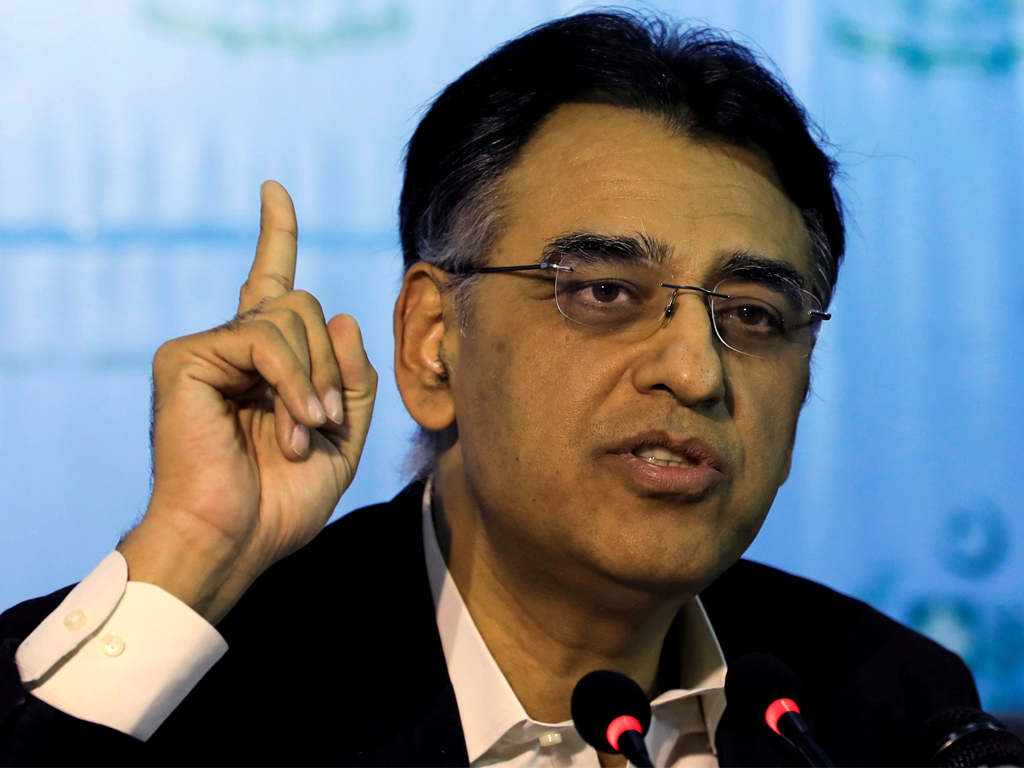
The first meeting of the 9th National Finance Commission (NFC) award under the chairmanship of the Federal Finance Minister Asad Umar and at his suggestion, agreed to include provinces in policy dialogue with the International Monetary Fund (IMF) when setting fiscal targets in the medium term. The meeting also agreed to base the award on the 2017 census results though these results continue to be controversial and have yet to be approved in the Council of Common Interests, and to set up six working groups to make recommendations including: (i) macroeconomic framework and benchmarking; (ii) vertical distribution of the divisible pool; (iii) horizontal distribution of the divisible pool; (iv) straight transfers; (v) initiation of measures to simplify tax procedures; and (vi) integration of FATA with KPK.
This raises the spectre of the imminence of an IMF programme, though sources continue to maintain that the Prime Minister is not yet convinced that the country needs to seek a politically challenging IMF bailout package as its approval by the Fund Board would require a revisit of major policy decisions taken so far by the government, including its fiscal policy and industrial promotion package (not yet passed through parliament titled second amendment finance bill 2019). This is notwithstanding the emphasis on engaging provinces while setting the fiscal targets in the medium-term which may allow the government some negotiating room for the current year at least.
At the outset, it is necessary to acknowledge the spirit of cooperation and consultation that Asad Umar instilled in the meeting which is in marked contrast to the high-handed approach to the NFC award, pending since 2015, taken by former Finance Minister Ishaq Dar who bears full responsibility for derailing the process till his ignominious departure from the country in 2017 (though he too had set up working groups as a way to deal with issues facing the centre after the 2010 7th NFC award). These issues are two-fold.
First, shrinking federal government revenue (as the share of the provinces in vertical distribution was raised from 49 percent to 56 percent during 2010-11 and 57.5 percent during the remaining years of the award) without a commensurate decrease in allocations on those subjects that were devolved as per the 18th Amendment due to continued lack of provincial capacity. The federal government's representative rightly pointed out that while the federal share of the divisible pool was slightly less than the annual outlay on debt servicing and defence and that the rest of the Centre's expenditure was through borrowing. This of course does not include other taxes (petroleum levy, gas development surcharge and gas infrastructure development cess) accounting for around 300 billion rupees per annum and non-tax revenue of around 900 billion rupees per annum - amounts insufficient to meet the annual outlay of over 1.3 trillion rupees on badly run state-owned entities including white elephants Pakistan Steel Mills, Pakistan International Airlines and Pakistan Railways.
Subsequent to the NFC and 18th Constitutional Amendment, the federal government began to itemize provincial surplus as a revenue source to bridge its deficit - a source that was almost routinely grossly overstated especially last year with elections scheduled in July. In this context, to get provinces on board while negotiating with the IMF may lead to setting a realistic target of the surplus expected of each province.
Secondly, the concerns of the federal and provincial governments were drawn during the meeting. The Sindh Chief Minister supported by the Punjab Finance Minister, raised concerns on lower than projected revenue during the current year as a consequence of finance amendment bills one and two for which responsibility rests with the federal government. The Sindh Chief Minister reiterated his earlier suggestion that provinces be allowed to collect sales tax on goods for the centre for a fee as collections would improve (as they did when the provinces began to collect sales tax on services). The Punjab Finance Minister urged provinces to focus on generating their own resources and urged the government to incentivise those provinces in horizontal distribution of resources that show better revenue growth.
Additionally, Sindh laid the responsibility of FATA on Khyber Pakhtunkhwa (KPK) after the merger, yet the centre rightly objected stating that this responsibility cannot be on KPK and a subgroup was set up to analyze the merger of FATA with KPK.
There is no doubt that the Centre's resources have shrunk considerably as a consequence of the 7th NFC award though expenditure has continued to rise. In this context, the focus cannot only be on raising revenue but also on reducing expenditure and raising capacity in provinces to deal with subjects in their domain. While debt servicing cannot be reduced for fear of a possible default yet all other expenditures must be arrested for starters and brought down next year till the ongoing economic impasse is resolved.
Be that as it may, it is relevant to note that a finance minister plays a critical role in an NFC award and one would hope that Umar continues to play a role akin to that of Shaukat Tarin during whose tenure the 7th award was approved unanimously.